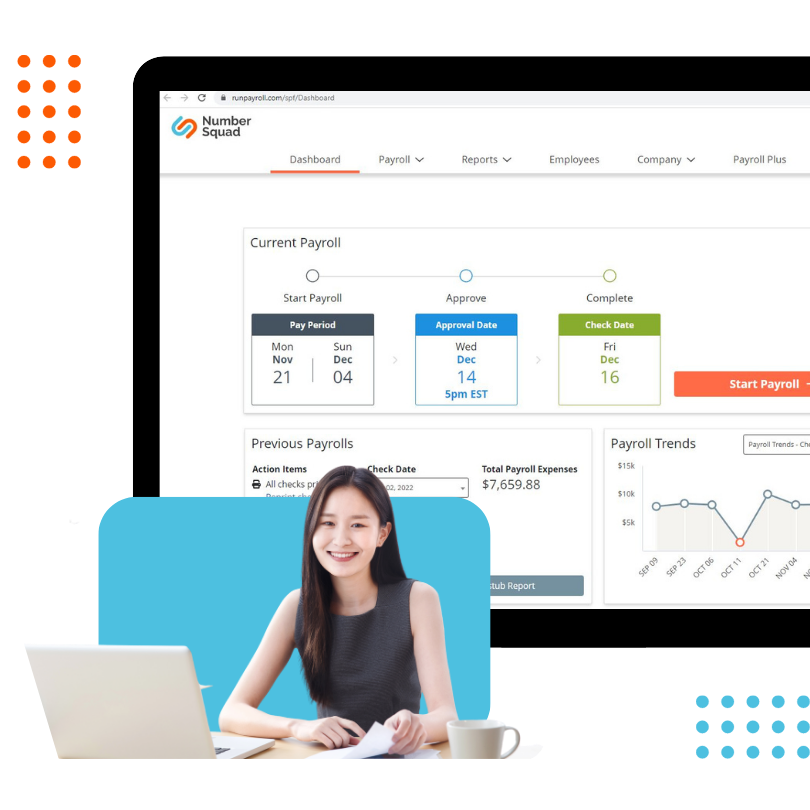
Smart Payroll Solutions for S-Corps and Small Business Owners

A payroll solution for small businesses, self-employed pros, and S-Corp owners that delivers easy setup, compliance, tax savings, and full payroll management.

Get Started
professional services taxes

All-in-One Payroll Support for Small Businesses

On-time payroll and compliance made easy—so you can grow your team.

freelancer taxes, payroll services

Easy Setup

We make payroll easy to start. Our team sets up your accounts, guides you through each step, and gets everything running quickly and swiftly.

Dedicated Payroll Support

Dedicated Support

You get a payroll specialist who understands small businesses. Your rep is easy to reach, fast to respond, and ready to help whenever you need support.

S-Corp owners choose a reasonable salary

Tax-Saving Payroll

We help S-Corp owners choose the right salary, adjust withholding, and report benefits correctly so your business can save more on taxes.

Hassle-Free Compliance

Hassle-Free Compliance

We stay updated on payroll laws, handle all filings, tax payments, and paperwork, and help prevent costly penalties so your business stays stress-free.

Get more convenience and savings by bundling payroll with full financial support.

Tax Filing

Stress-free, accurate, and on-time tax filing for your business and personal returns—saving you money and effort.

Find Out More About Our Tax Service

Bookkeeping

Stay organized with monthly bookkeeping that supports cash-flow management and stress-free tax filing.

More About Our Bookkeeping

Company Registration

An LLC isn’t always the best tax move. We help you pick the structure that fits your startup.

More About Company Registration

S-Corp Election

Get your S-Corp election done right with fast, accurate, and secure Form 2553 filing, even for late submissions.

More About S-Corp Election

Book a free 30‑minute consultation before year‑end to see how much you can save.

Stress-free payroll managment

Get all the payroll features you need to grow your business.

Grow your Team

Paycheck Processing

Direct Deposits

Payroll Reports

Payroll Tax Return Filings

Payroll Tax Payments
See Our Pricing

Single touch payroll

Payroll outsourcing that saves you time and trouble. Payroll apps with simple platform and seamless features.

Online Payroll

Get your payroll done anytime from anywhere.

Mobile app

Mobile access to process payroll on the go.

Employee Self-Service

Gain efficiency with less burden.

Responsive

Flexible payroll options for unexpected moments.

Manager Self-Security

Access your information quickly and conveniently.

Affordable pricing

Simple, straightforward pricing for everything your payroll needs.
Expert on laptop

Help from payroll experts, who care
about your team

Custom Payroll Solutions

Registration
If you are a new employer, we help you register to the correct agencies.

Support
Get accurate and fast answers to your all payroll and tax questions.

IRS Letters
We help you to understand and respond all payroll tax letters and IRS notices.

Payroll taxes filed

Our experienced tax professionals can guide you through the payroll tax process and help you devise a sound decision.

Federal payroll tax returns
We calculate and file all your federal payroll tax returns to the IRS. No additional fees.

State payroll tax returns
We file all your state payroll tax forms to the right agency. No additional fees.

W2 & W3 forms
We file your W2 and W3 forms to the Social Security Administration.

W2 forms for employees
Accurate and timely w-2 forms are prepared automatically for your employees.
Payroll-taxes

Simple Payroll Guide for Small Business Owners

Choosing the right payroll service is an important decision for small business owners and S-Corp owners. The right provider helps you stay compliant, avoid penalties, save money, and reduce office workload. Use this short guide to pick the best payroll service for your business.

Know Your Business Needs

Before comparing payroll companies, take a moment to understand what your business requires.

  • Employee Type: Check if your team is hourly, salaried, or in multiple states. Make sure the payroll provider can handle all needed tax rules.

  • Business Size: If you have under 10 employees, choose a service that fits now but can grow with you.

  • Payment Options: Decide if you need direct deposit, payroll cards, or access to pay stubs and tax forms online.

A clear picture of your needs helps you avoid choosing the wrong service.

Look for Essential Payroll Features

A strong payroll provider should cover the essentials small businesses depend on.

  • Full Automation: Automatic paycheck calculation, tax withholding, and W-2/1099 forms save hours each month.

  • Tax Compliance: The service must file federal, state, and local payroll taxes for you. Penalty protection is a big plus.

  • Easy Integrations: Your payroll should sync with tools you already use, such as QuickBooks, Xero, and time-tracking systems.

These features reduce mistakes and help keep everything running smoothly.

Compare Pricing, Security, and Support

Don’t choose a payroll service based only on the lowest price.

  • Cost: Compare the monthly base fee and per-employee fee. Ask about extra charges—especially for year-end W-2/1099 forms, setup, or bonus payrolls.

  • Security: Payroll includes sensitive data. Choose a provider that uses encryption and multi-factor authentication.

  • Support: Good customer support saves time and prevents mistakes. Look for fast response times and strong reviews.

A reliable provider protects both your business and your employees.

Small Business Payroll Resources

Small business payroll involves more than paying employees. It requires understanding tax rules, choosing the right payroll setup, and staying compliant year-round. These resources help small business owners and S-Corp owners reduce risk, avoid penalties, and manage payroll with confidence.

S-Corp Payroll & Compliance

Reasonable Compensation

S-Corp owners must pay themselves a “reasonable salary” to meet IRS rules and avoid penalties. This guide helps you choose the right salary amount so you can legally reduce self-employment taxes while staying fully compliant.

Complete S-Corp Payroll

Learn how to run payroll for S-Corp shareholders, including salary processing, accountable plans, and accurate W-2 and K-1 reporting. These steps help your business stay organized and audit-ready.

S-Corp Payroll Taxes

Get help with payroll tax registration, payment schedules, and reporting. Proper tax payments keep your S-Corp compliant and protect you from costly IRS or state penalties in VA, MD, and D.C.

Payroll Best Practices for All Small Businesses

Multi-State Payroll Compliance

If your business operates in more than one state, payroll becomes more complex. This resource explains how to manage multi-state tax rules, registration requirements, and filings to stay compliant across state lines.

Salary vs. Wage

This guide explains the difference between paying employees a salary or hourly wage and helps you choose the right structure for your team. Understanding this distinction supports labor-law compliance and accurate payroll processing.

Switching Payroll Providers

If you’re unhappy with your current provider, timing matters. Learn the best moments to switch payroll services to avoid errors, missed tax payments, and administrative headaches—especially during year-end or quarter changes.

Frequently Asked Questions About Small Business Payroll

What is the difference between an Employee (W-2) and an Independent Contractor (1099), and why does it matter?

Answer: The difference lies in the level of control you have over the worker.

  • Employee (W-2): You control what, when, where, and how they work. You are responsible for withholding and paying their payroll taxes (FICA, FUTA, SUTA) and providing benefits.

  • Independent Contractor (1099): They control how they do the work, using their own tools and methods. You are not responsible for withholding taxes; they pay their own self-employment taxes.

Why it Matters: Misclassification is the most common and costliest payroll error. The IRS imposes significant fines, back taxes, and penalties if you incorrectly classify an employee as a contractor to avoid paying payroll taxes.

What payroll taxes do I have to withhold and pay?

Answer: You are responsible for both the employee’s portion and the employer’s matching portion of certain taxes.

Tax Type Responsibility Amount (Current FICA Rates)
FICA (Social Security & Medicare) Shared: Withheld from the employee and matched by the employer. 7.65% from the employee + 7.65% from the employer = 15.3% Total
Federal Income Tax (FIT) Withheld: Deducted from the employee’s pay based on their W-4 form. Varies by employee
FUTA (Federal Unemployment Tax) Employer-Paid: Paid entirely by the employer. 6.0% (on the first $7,000 of wages, subject to state credits)
SUTA (State Unemployment Tax) Employer-Paid: (Except in a few states where employees also contribute). Varies by state and employer history

How often must I pay my employees?

Answer: The pay frequency is primarily dictated by state law, not federal law.

  • The Fair Labor Standards Act (FLSA) requires employees to be paid at least once a month.

  • Most states, however, mandate more frequent paydays (e.g., bi-weekly or semi-monthly). Bi-weekly (every two weeks, 26 pay periods) is the most common schedule in the U.S.

  • Key Rule: Once you set a pay schedule, you must maintain consistency and comply with your state’s minimum frequency requirements.

How do I handle overtime and the difference between Exempt and Non-Exempt employees?

Answer: This relates to eligibility for overtime pay under the FLSA.

  • Non-Exempt Employees: Are legally entitled to overtime pay (1.5 times their regular rate) for any hours worked over 40 in a single workweek. They are typically paid hourly.

  • Exempt Employees: Are not eligible for overtime pay. To qualify as exempt, an employee must meet three tests:

    1. Be paid on a salary basis.

    2. The salary must meet a minimum threshold (e.g., $684 per week, or $35,568 annually as of early 2024).

    3. Perform specific executive, administrative, or professional job duties.

  • Mistake to Avoid: Simply paying an hourly employee a salary does not make them exempt.

What paperwork is required when I hire a new employee?

Answer: Two federal forms are mandatory for every new employee before they start working:

  • Form I-9 (Employment Eligibility Verification): Used to verify the identity and employment authorization of individuals hired for employment in the United States.

  • Form W-4 (Employee’s Withholding Certificate): Used by the employee to tell you how much federal income tax to withhold from their paycheck.

You will also need to collect personal information (name, address, SSN), direct deposit bank details, and any applicable state tax forms.

How long do I need to keep payroll records?

Answer: You must maintain detailed records to satisfy both the IRS and the Department of Labor (DOL).

  • IRS Requirement: Generally, you must keep all payroll tax records (tax returns, deposit slips) for at least four years.

  • FLSA/DOL Requirement: You must keep records of wages, hours worked, and other employment information for at least three years.

  • Best Practice: Keep detailed records (timesheets, W-4s, pay stubs) for seven years to cover all major tax and labor statutes of limitation.

When is the best time to switch to a new payroll service?

Answer: The absolute best time to switch is at the beginning of the calendar year (January 1st).

  • This allows the new provider to handle the entire year’s tax reporting, including all quarterly filings (Form 941s) and the year-end W-2 and 1099 form generation, using fresh data.

  • The beginning of a fiscal quarter (Jan 1, Apr 1, Jul 1, Oct 1) is also manageable, as it simplifies the transfer of Year-To-Date (YTD) wage and tax information between the old and new providers.

Serving small businesses all over the US

NumberSquad is an online Small Business Accounting firm. We file small business taxes across the US and locally in DMV area.

Our office locations:

Tysons Corner, VA Office

1775 Tyson Blvd
WeWork Space
Tysons Corner, VA 22102
(Appointment only)

Reston, Virginia Office

1900 Campus Commons Dr.
Suite 100
Reston, VA 20191
(Appointment only)

Rockville, Maryland Office

1 Research Court
Suite 450
Rockville, MD 20850
(Appointment only)

Recent Posts / View All Posts

Small‑Business Accounting & Tax Professionals: A Glossary

Monthly Financial Review: Simple Budget vs Actual Tracking for Busy Owners.

| Uncategorized | No Comments
A monthly financial review is a short money check-in you do once a month. It helps you see what is working, what is not, and what to fix next. It…
bookkeeping workflow

Bookkeeping Workflow: The 2026 Game Plan for Small Businesses

| Uncategorized | No Comments
If you are self-employed, bookkeeping usually gets pushed to “later.” You handle clients, marketing, delivery, and life. Then suddenly it’s the end of the quarter or the end of the…
financial report review

Year End Financial Statements Explained: P&L, Balance Sheet, Cash Flow (What you have to Check)

| Uncategorized | No Comments
If you are self-employed, your “reports” might be a bank app and a feeling like, “I think I did okay this year.” That’s normal. But at year end, guesses can…
bookkeeping for tax season

Small Business Year End Checklist 2025: Close Your Books & Get Tax Ready

| Uncategorized | No Comments
The end of the year usually brings a mix of holiday cheer and a little bit of "financial fog." If you are a self-employed creator, a freelancer, or a small…