
An S-Corp election can save small business owners thousands in taxes when done correctly. Our S-Corp specialists help confirm whether an S-Corporation is the right structure for your business, then file your Form 2553 accurately and on time—making the entire process easy and stress-free.
Effortlessly submit your S corp election form (Form 2553) with a user-friendly, precise, and cost-effective solution.
We file your S-Corp election accurately, making the process simple and stress-free.
Missed the deadline? We can file your late S-Corp election and help get it approved.
Our experts help you determine if an S-Corp makes sense for your business.
Get S-Corp filing for $50, or complete company registration for $150.
Streamlined filing process – file your 2553 form fast and easily.

Before setting up an S Corporation (S Corp), you typically need to have a legal entity, LLC or Corporation, in place.
Registering your sole proprietorship as a single-member LLC can provide you with personal liability protection and additional benefits for your business.
Obtaining an EIN (Tax ID Number) for your single-member LLC can help fulfill your legal requirements and facilitate banking and tax-related activities.
Filing an S-corp election for your single-member LLC can provide tax benefits and potential savings while maintaining the flexibility of an LLC structure.
An S corporation (S corp) is a federal tax status. It lets business profits “pass through” to the owners’ personal tax returns. The business usually avoids federal corporate income tax. Owners still pay tax on their share of profit.
S corps also offer limited liability protection like other corporations. That means business debts and lawsuits usually stay with the company. Your personal assets often get protection.
Many small businesses choose S corp status to reduce self-employment taxes. Owners pay payroll tax on W-2 wages. Remaining profit may be taken as distributions. Distributions can avoid Social Security and Medicare taxes in many cases.
S corps are not perfect for every business. They require more paperwork than a basic LLC. They also require careful payroll setup and clean records. If you operate in Northern Virginia or the DMV, state rules can also affect the outcome.
An S corp has owners called shareholders. Shareholders often work in the business. When they do, the IRS expects “reasonable compensation” paid through payroll. That means a W-2 salary with payroll taxes.
After payroll and expenses, the business may pay distributions. Distributions usually follow ownership percentages. You cannot “custom split” profits like many LLC operating agreements allow.
The S corp files an annual return on Form 1120-S. Each shareholder receives a Schedule K-1. The K-1 reports that owner’s share of income, deductions, and credits.
S corps can also pass through losses. This may offset other income, depending on basis and at-risk rules. These rules get technical fast. Good bookkeeping helps you avoid surprises.
An S corp election is the IRS filing that turns on S corp tax treatment. The election does not create the business entity. You first form a corporation or an LLC at the state level. Then you elect S corp status for federal tax purposes.
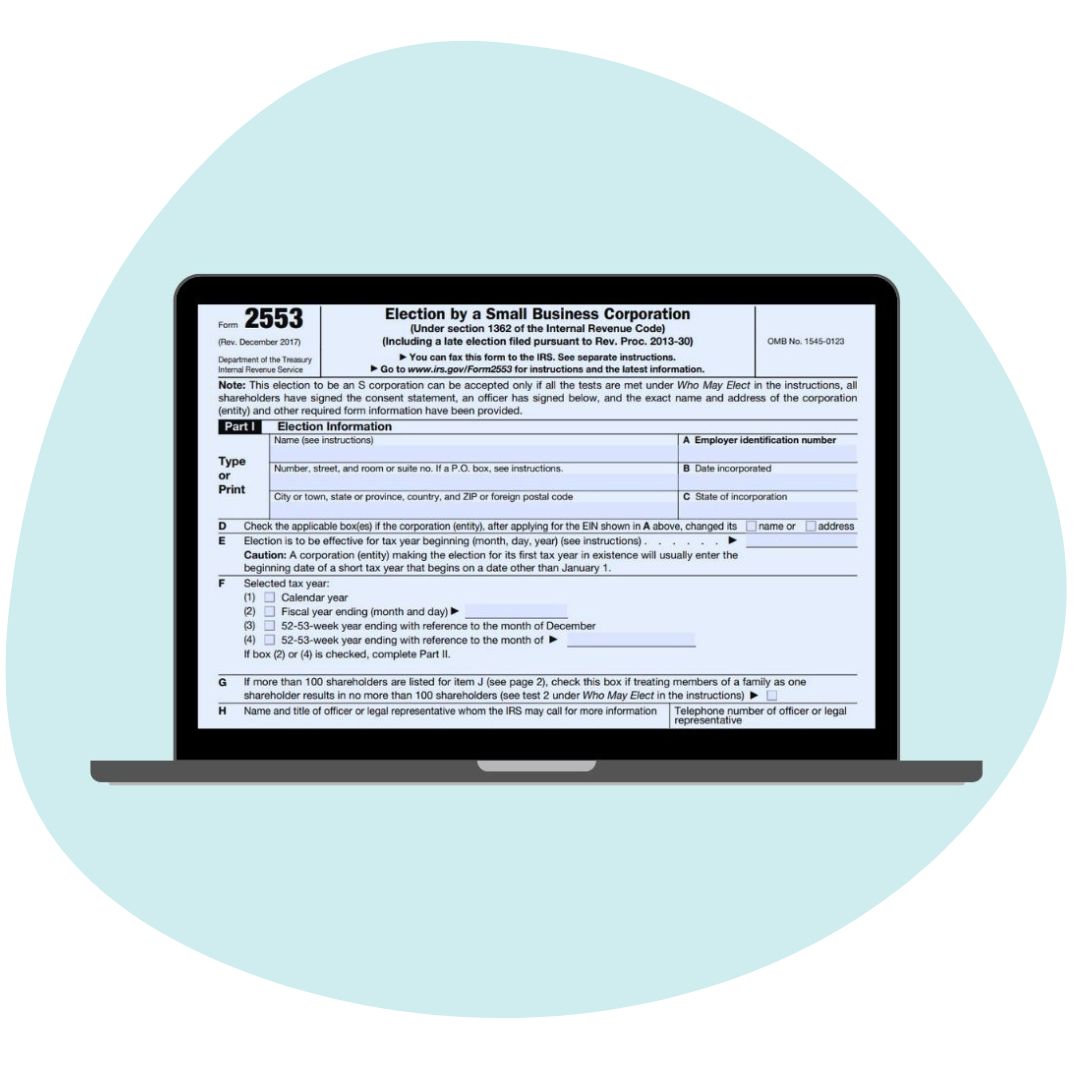
The election is made using IRS Form 2553. All shareholders must consent and sign. The form also asks for ownership details and the effective date.
Timing matters. Many small businesses aim to elect early in the tax year. Late elections can be approved in some cases, but you must show reasonable cause. A professional can help you avoid delays and rejection.
In practice, an S corp election is a tax strategy move. It can lower payroll taxes for profitable owner-run businesses. It also creates strict compliance rules. You need payroll, minutes, and accurate books.
S corps have strict IRS eligibility rules. Your business must be a domestic entity. It must have 100 or fewer shareholders. Shareholders must usually be U.S. citizens or resident individuals.
S corps generally can have only one class of stock. Voting rights may differ, but distribution rights must be equal. This limits how you can structure investor deals.
Some entities cannot be shareholders. Partnerships and most corporations are not allowed. Nonresident aliens also cannot be shareholders. Certain industries also face restrictions.
If you plan to raise venture capital, these limits matter. Many investors prefer C corps for stock flexibility. If you plan to stay owner-operated, S corp status may fit well.
Step 1: Form your legal entity. Most owners form an LLC or corporation with the state. In Virginia or Maryland, this happens through the state filing agency.
Step 2: Get an EIN. You will use it for payroll, banking, and tax filings. Many businesses also need local licenses.
Step 3: File IRS Form 2553. Choose your effective date carefully. Make sure every owner signs the form.
Step 4: Set up payroll for owner-employees. Pay a reasonable salary. Withhold and remit payroll taxes.
Step 5: Maintain compliance. Keep meeting notes, resolutions, and financial records. File Form 1120-S each year and issue K-1s.
If you operate in Fairfax, Tysons, Reston, or Rockville, local support matters. A local team helps you align payroll, bookkeeping, and tax filing.
S Corporation status can be a strong tax strategy for the right business. It can lower payroll taxes and improve planning. It can also add compliance risk when done wrong.
The best time to plan is before you elect. You need to confirm eligibility, set a reasonable salary, and build clean bookkeeping. You also need to match the structure to your growth plan.
NumberSquad helps small business owners across Oakton, Fairfax, Tysons, Reston, and Rockville. We handle S corp elections, payroll setup, monthly bookkeeping, and proactive tax planning.
If you want to know whether an S corp fits your numbers, talk with a tax expert. A short review can prevent expensive mistakes later.
NumberSquad is an online Small Business Accounting firm. We file small business taxes in 50 states and District of Columbia.
Our office locations:
10455 White Granite Dr
Suite 425
Oakton, VA 22124
(Main Office)
LLC offers flexibility but no tax saving benefit. S Corp provides tax advantages and limited liability protection.
Learn MoreCorporation offers limited liability; S Corp adds tax advantages and pass-through taxation benefits.
Learn MoreS Corp offers tax advantages, limited liability protection, and potential for easier access to capital.
Learn MoreA CPA or an Enrolled Agent can provide expert guidance on tax compliance and financial strategies for S Corps.
Learn MoreS-Corp payroll includes officer salary, subject to reasonable compensation guidelines and payroll tax obligations.
Learn MoreThe 2553 Form is used to elect S Corp status for a corporation or LLC with eligible shareholders for potential tax-saving benefits.
Learn MoreAn S-Corp tax calculator compares taxes to show if an S-Corporation or sole proprietor setup saves you more money.
Learn MoreThe filing deadline for Form 2553 depends on when you want your S-Corp election to take effect.
To apply the election for the current tax year, you must file Form 2553 no later than two months and 15 days after the start of the tax year. You may also file at any time during the prior tax year to have the election take effect on January 1 of the following year.
For a new business, the deadline is two months and 15 days after the date the corporation or LLC is formed or begins business operations, whichever comes first.
Missing the deadline does not always end your options. The IRS may allow a late S-Corp election if you can show reasonable cause.
If you miss the deadline, your S corp election usually will not apply to the current tax year. Your business will continue to be taxed under its existing status. That may be a C corporation, a sole proprietorship, or a partnership, depending on how you are set up.
The good news is that the IRS often allows late S corp election relief. To qualify, you must show reasonable cause for the delay. Common reasons include relying on incorrect professional advice or an administrative oversight. You must also correct the issue promptly after discovering it.
To request relief, you file Form 2553 and attach a written statement. The statement explains why the election was late and confirms you intended to be taxed as an S corp. If approved, the IRS may treat the election as timely.
Our team supports business owners across Oakton, Fairfax, Tysons, Reston, and Rockville, MD. We review your situation, prepare the correct filings, and help you stay compliant year-round. Talk to a NumberSquad tax expert to make sure your S corp election is done right the first time.
You must file Form 2553 with the Internal Revenue Service (IRS). The easiest way is to fax the completed 2553 form to the appropriate fax number based on your location:
For U.S. fax numbers:
For international fax numbers, you can visit the IRS website or contact the IRS directly for the appropriate fax number based on your location.
Learn more about How to file Form 2553.
A reasonable salary is the wage an S corp owner-employee must receive for the work they perform. The amount should match what a similar professional earns in the open market. This salary is paid through payroll and is subject to Social Security and Medicare taxes.
This requirement is critical because it is a major IRS enforcement focus. The IRS uses it to stop owners from avoiding payroll taxes by taking most income as distributions. Paying too little salary increases audit risk and can trigger penalties, back taxes, and interest.
Most S corp owners use a two-part compensation structure. First, they pay themselves a reasonable W-2 salary that reflects their role, skills, and time worked. Second, they take remaining profits as distributions. These distributions are generally not subject to payroll taxes.
Setting the salary correctly protects your S corp status and supports legal tax savings.
The s corp salary 60/40 rule suggests a reasonable salary allocation for S Corp owners, with approximately 60% as salary and 40% as distributions, considering factors like roles, industry standards, and business profitability.
Yes, an S Corp can own an LLC. This is known as a subsidiary structure, where the S Corp holds the ownership interest in the LLC while maintaining its separate legal and tax status. The LLC may need to have S-corp status as well to qualify QSub. A qualified subchapter S subsidiary (QSub) is a subsidiary corporation that an S Corporation wholly owns.
No. An S corp election does not provide asset protection by itself. Asset protection comes from the legal entity you form at the state level, such as an LLC or a corporation.
The S corp election only changes how the IRS taxes your business. It does not create a new entity, and it does not add liability protection.
If you formed an LLC or a corporation, you keep the liability protection that structure provides. Your personal assets are generally protected from business debts and lawsuits, as long as you follow proper business formalities.
Think of the S corp election as a tax strategy, not a legal shield. To stay protected, you must maintain good records, separate business and personal finances, and comply with state rules.